Wednesday, July 26, 2006

For Those of You Contemplating Purchasing a Compaq/HP Notebook Computer

If you are thinking about purchasing a Compaq/HP notebook computer, allow me to give you our family history with these notebooks.

1. In 2003 we purchased a Centrino based Compaq notebook for our son. It worked like a charm for 18 months. Then, things began to go wrong. Short story is that after 4 trips to Best Buy for repairs, resulting in 7+ weeks of no notebook computer, Best Buy declared it a lemon. Fortunately we had purchased the extended warranty, and we were able to get it replaced for no cost. If you purchase a computer warranty from Best Buy, be aware of the fact that you are able to replace it for a computer costing an equivalent amount -- not with one with an equivalent configuration. Some Best Buy staff will try to get you do the latter, when the former is what the warranty allows for -- and is a much better deal. So, with his new replacement Compaq/HP notebook computer, my son purchased the Best Buy extended warranty.

2. Now that my son's new Compaq/HP notebook computer is about 11 months old, he has been experiencing problems for about 3 months. When he first noticed the problem he returned it to Best Buy and after a week they returned the computer. They had cleaned the fan -- because the computer appeared to be overheating and then would turn itself off. That seemed to solve the problem. However, in the last 2 months the problem has gotten worse and worse. Now the computer regularly shuts itself off whenever it feels like it -- which makes it very difficult for him to work or do anything of substance with it. So, when he gets back from Korea, it's back to Best Buy.

3. The IT Department where I work purchases only Compaq/HP computers. I have had my most recent HP notebook for about 16 months. Now the keyboard is beginning to act up. First the "a" key didn't want to work -- then a week later the "e" key doesn't work, and today the "shift" key is misbehaving. So, when I get back from my sabbatical/holidays, I will need to get it fixed.

UPDATE: SEPTEMBER 29, 2006

4. My son returned from Korea with his HP notebook not working at all. It went back to Best Buy and 2 weeks later it was returned -- with a new motherboard! The notebook is now working well. BUT, remember, buy the extended warranty. We think that in another year, he'll get a new notebook courtesy of that warranty, because this one will have needed at least 2 more repairs.

My advice is simple:
  • Don't buy a Compaq/HP Notebook Computer.
  • IF you do decide to purchase one, be sure you have a 3 year warranty that covers everything -- because everything will go wrong.
  • Seriously consider purchasing a Dell notebook. My experiences with Dell notebooks have been very positive. And, now that Apple has come to it's senses and is using Intel processors, it may be worth looking at Mac Notebooks (though I know 3 people who have had serious hard disk problems with their Macs). Macs may be the way to go, especially once they have got the running Windows thing down pat.

Sunday, July 23, 2006

Communities First -- Jay Van Groningen

Communities First is an excellent introduction to Christian-based community development -- locally and globally. The book is not just a theological treatise -- though it deals with some theology -- but mostly a very practical, hands-on guide to getting started in seeing your community transformed by the grace of God.

One of the key issues the author raises is this. Does your church want to do ministry to your community, or do you want to do ministry with your community? Ministry to your community will result in primarily relief ministries -- and little individual or community transformation. Ministry with your community will focus on community transformation. The former is much easier than the latter.

Doing community transformation with a community, at a minimum requires:
  • Developing and sharing vision WITH the people in your community -- even the ones who don't go to or like your church.
  • Becoming PART of the community. Your church members need to live intentionally in the community you want to reach. Your church needs to function as a genuine part of the neighborhood -- not just as the owner of land and buildings that happen to be located in the neighborhood. The people in the community need to have a sense that you are part of them -- they need to have a sense of "community" with your church.
  • Sharing ownership with the neighborhood of the projects and ministries you are involved in. If there is no ownership -- there will be no permanent change.
The implications of just these 3 points for the average local church are huge and revolutionary. It seems to me that the great majority of churches minister TO communities, not WITH. We know what the community needs better than the people who live there -- or at least that is how we often act. We really don't like sharing power -- especially if we are a large, successful church.

Perhaps this is why even though hundreds of churches are planted across the USA every year, we really see little genuine community transformation. Most churches have a vision for individual transformation, not community transformation -- and those churches that do want to see their communities transformed are ministering TO -- not WITH.

If you have influence in your church, and you have a heart for community transformation, I HIGHLY recommend this book.

Thoughts from the Beaches of the Big Island of Hawaii -- Part 4

In the July 2006 issue of Christianity Today, Philip Yancey wrote a brief article entitled The Lure of Thoecracy. Here are some of his thoughts.

Yancey tells of a Muslim man who made the following statement to him.

I find no guidance in the Qu'ran on how Muslims should live as a minority in society and no guidance in the New Testament on how Christians should live in the majority.

This man put his finger on a central difference between the two faiths. Christianity, tends to thrive cross-culturally and counter-culturally, often coexisting with hostile governments. Islam, geographically anchored in Mecca, was founded simultaneously as a religion and a state.

In many ways Muslims see the state and their faith as one. Islam is not a private religion -- it is very public. It is a way of life. In many ways, Islam is theocratic.

What Yancey and I find interesting is that some of the very things many Christians resist in Islam, are the very things many Christians find tempting. Christians seek political power and a legal code that reflects Biblical morality (hence the focus on amendments to the constitution on marriage, homosexuality, banning abortion, etc.). Christians are rightly concerned about raising their children in a climate or moral decadence. Christians, like Muslims see others as a stereotyped community, rather than as individuals.

I have heard from many Christians the idea that we need to change laws to reflect Biblical values in order to preserve our Christian heritage. This has got me wondering -- maybe Christians and Muslims are not that far apart. Both of us are tempted to impose our worldview on the nation we live in. The Qu'ran encourages Muslims to do this. The Bible however, seems to be silent on this issue -- prefering to see individuals and communities transformed from within by the grace and power of God.

I wonder what we should be spending our time on. Signing petitions and attempting to exert political pressure -- or simply doing the Kingdom of God -- living justly, loving mercy, and walking humbly with our God?

Thoughts from the Beaches of the Big Island of Hawaii -- Part 3

I read an article in Christianity Today on the Didache. One of the quotes sparked my interest. Apparently the writes of the Didache in addressing issues related to the church, said that if a visiting speaker comes, and wants money, that is a sure way to tell that he/she is not from God.

How do you think this would go over in today's evangelical/charistmatic circles? Public speaking in churches, at conferences, etc. is quite lucrative (our church pays a visiting speaker at least US$2,000 for 3 services -- and I know we are on the low end). Having dealt with evangelical/charistmatic speakers over the years, I know that many of them ask for honorariums and benefits (golf trips, certain kind of hotel rooms, etc.) that the average person in a church would never be able to afford. Our Christian celebrities have come to expect certain luxuries. I was told by the senior pastor of a mega-church (who often benefits from these luxuries) that this is simply the price we have to pay for for getting speakers who will draw a large crowd. Well known speakers expect to be catered to, and we need to do the catering!

Wonder what the early church fathers would say about that? Wonder what Jesus would say about that?

Thoughts from the Beaches of the Big Island of Hawaii -- Part 2

As a graduate of Fuller Theological Seminary (School of InterCultural Studies) I get the Fuller publication entitled Theology News and Notes. The Winter 2006 edition contained an article regarding the relationship of pyschology and religion -- Christianity in particular. Reading it reminded me of some of the things I had read in Generous Orthodoxy and a couple of other books I have recently read. Here is a summary of the 3 major concerns the author of this article expresses.

1. Christianity as a Utilitarian Concern in Psychology Christianity may be useful in helping people. In other words, prayer, meditation, church attendance, etc can all be therapeutic. So, just as Prozac or other drugs alter our moods and help us feel better, engaging in acts of personal piety can do the same. To value Christianity for it's usefullness is really a form of idolatry.

Is my Christianity utilitarian? Is the Gospel we proclaim a utilitarian one? Is this our approach to people -- both believers and not-yet-followers of Jesus?

2. Christianity in the formula for health may well be consumerist. Since capitalist cultures tend to take on the character of an exchange of merchandise, religion becomes simply a commodity one can select and purchase. If Christian interventions work, then religion is a cost-effective way of addressing rising health costs. In consumerism, religion and health are commodities, medical and psychological practitioners are purveyors, and health insurers are brokers. But is not health a gift rather than the result of a contract in which a Prozac god is bound to fulfill an obligation to reward devotion with health? We need to ask not "what God can do for us", but rather, what can we do for God. The answer my friend, is not blown in the wind, but found in Micah 6:8 -- to do justly, to love mercy, and to walk humbly with my God.

3. Christianity associated with health is private. In our culture religion is private -- we each believe or worship what we want to, and as long as we don't push our beliefs/religion on each other, we are all okay. This idea reflects the individualism of Western cultures -- the self as autonomous, self-interested and unencumbered by responsibilites for others. Healing is not assumed to occur in the context of a community, and hence an individualistic culture constructs a Christianity that helps me achieve my mental and physical health.

All of this gets me thinking not only about the state of the church in the USA, the church I am part of, and particularily of my faith. Is my relationship with God primarily characterized by consumerism? Is my faith utilitarian? How does our proclamation of the Gospel (in word and deed) need to change? How do I need to change?

Thoughts from the Beaches of the Big Island of Hawaii -- Part 1

For the past week I have been on the Big Island of Hawaii. My wife and I are here for two weeks celebrating our 25th wedding anniversary. We love the Big Island. It wouldn't be hard to live here. I spent 5+ months here in 1977. Returned in 1986. Introduced my wife and son to the BI in 2002. My son spent 2 months here in 2004 volunteering time with the University of the Nations -- and here we are again in 2006. It is the perfect ending to my sabbatical time (though technically right now I am not on sabbatical, I am on holidays).

My wife and I have done some tourist things, but mostly we have spent time at various beaches, snorkling and reading. I've been reading various books and articles and thought I would share some of the thoughts I've had -- especially from some of the articles I've read.

A New Kind of Urban Christian -- Timothy J. Keller -- Christianity Today (May 2006)

Keller believes that cities are the key to reaching nations. Nothing new here. Let me summarize his key points.

1. More Christians should live long-term in cities. If we don't live in the cities of our nation and the world in at least the percentage of the general population, we will lose our influence on the culture. Christians who live in large cities, and who counter-culturally LIVE their faith can influence the arts, business, academia, publishing, the helping professions and the media in ways that will have an impact on their entire nation. Instead of fleeing to the suburbs or rural areas, or forming Christian ghettos (in actuality or in mindset) Christians should be engaging their culture by working in those areas that have the most power to influence.

2. Christians should be a dynamic counter-culture. Christians are called to be an alternative city within-the-city showing a Kingdom of God culture in how sex (abstinence before marriage and fidelity within), money (radical generosity, helping the poor, treating employees with fairness, justice and generosity) and power (power-sharing and relationship-building between races, social and economic classes and those alienated from society and the Body of Christ) can be used in non-destructive ways.

3. Christians should be a community radically commited to the good of the city as a whole. We must move out to sacrificially serve the good of the whole human community -- especially the poor. Revelation 21-22 make it clear that the ultimate purpose of redemption is not to escape the present material world, but to renew it (all creation groans). God's purpose is not only saving individuals but the world (see A Generous Orthodoxy by Brian McLaren) and inaugurating a new world order based on justice, peace and love -- not power, strife and violence and selfishness. Christians should not go to the city in order to get political, economic and social power so they can impose their agenda. Rather, Christians should go to the city to serve the city -- not just our own tribe. We must lose our power to find true power -- what Greg Boyd calls "power-under" in his book The Myth of a Christian Nation. Christianity will not be attractive enough to win influence except through sacrificial service ("power-under" -- doing the Kingdom) to all people regardless of their beliefs. As we do this, we will be misunderstood and sometimes attacked -- but we will gain the respect of those around us -- AS LONG AS we exercise "power-under" rather than "power-over".

4. Christians should be a people who integrate their faith with their work". If we don't integrate our faith, our Biblical worldview and our values into EVERYTHING we do, then we will not influence our culture.

Friday, July 14, 2006

The Myth of a Christian Nation -- Gregory Boyd -- Part 2

Please read my previous post before reading this one.

After stating his central thesis, Boyd goes on to say the following:

For some evangelicals, the kingdom of God is largely about, if not centered on, "taking America back for God," voting for the Christian candidate, outlawing abortion, outlawing gay marriage, winning the culture war, defending political freedom at home and abroad, keep the phrase "under God" in the Pledge of Allegiance, fighting for prayer in the public schools and at public events, and fighting to display the Ten Commandments in the government buildings.

. . . this perspective is misguided, . . . fusing together the kingdom of God with this or any other version of the kingdom of the world is idolatrous and this fusion is having serious negative consequences for Christ's church and for the advancement of God's kingdom.

. . . What gives the connection between Christian and politics such a strong emotional force in the USA . . . is the longstanding myth that America is a Christian nation. . . . this foundational myth is a alive and well in the evangelical community . . . and is being embraced more intensely and widely now than in the past . . . because evangelicals sense it is being threatened. . . .

this nationalistic myth blinds us to the way in which our most basic and most cherished cultural assumptions are diametrically opposed to the kingdom way of life taught by Jesus and his disciples. Instead of living out the radically countercultural mandate of the kingdom of God, . . . this myth links the kingdom of God with certain political stances . . . and it has greatly compromised the holy beauty of the kingdom of God to non-Christians. This myth harms the church's primary mission.

Pretty strong words, wouldn't you say? What do you think? Are the majority of evangelicals in America idolatrous because they mix these two kingdoms? Is this sycretism? Is Christianity, America's tribal religion? Is this nationalistic myth blinding us, manipulating us, making us ineffective as God's people? Is it stopping us from truely being counter-cultural?

One of the things I remember vividly is being in a church service on the July 4th weekend in 2001. There were probably 1200 people in the service. We sang some worship songs -- and some people had raised their hands and were "getting into" the worship. The worship time was closed by a couple of patriotic songs including the "Battle Hymn of the Republic" and "God Bless America". As I watched the reaction of the people to these songs I was shocked. During these songs people REALLY worshiped. 3-4x as many people had their hands raised. People were swaying to the music, their eyes closed in what appeared to be "worship".

I remember standing there, looking around and thinking -- who are these people worshiping -- God or America? Maybe Boyd is right and we are an idolatrous people. Maybe we are more committed to America than to God, and that is why the church in this country is largely ineffective and shrinking in size. Perhaps, if we were more committed to God than to our country, evangelicals really would agents of spiritual, social and cultural transformation.

What do you think?

The Myth of a Christian Nation -- Gregory Boyd -- Part 1


About two weeks ago I finished Boyd's book The Myth of a Christian Nation. I have intended to review it, but have chosen not to until now. I have needed some time to think about what Boyd has written. At the same time I have been reading a book entitled God is not ... religious nice "one of us" an american a capitalist edited by D. Brent Laytham. Both of these books have been quite thought provoking. I've made some comments in previous posts about both books. What I intend to do in the next couple of days is write a series of short posts interacting with both books. Hopefully short posts will be more readable than long ones.

One of the things I find interesting is that Boyd thought that a sermon series that shrunk his church by 1,000 people was worth a book. Most senior ministers write books when attendance increases by 1,000 people as a result of a sermon series. But then Boyd has always thought a little differently.

Boyd begins his book by laying out his central thesis which is as follows:

I believe a significant segment of American evangelicalism is guilty of nationalistic and political idolatry. . . . evangelicals fuse the kingdom of God with a preferred version of the kingdom of the world (whether it's our national interests, a particular form of government, a particular political program, ...) I believe many of us American evangelicals have allowed our understanding of the kingdom of God to be polluted with political ideals, agendas, and issues.

A strong statement -- but one that I have by and large, discovered to be true among evangelicals across America. As a legal immigrant to the USA (I actually became a citizen last year) one of the first things that has become increasingly obvious to me is that the Kingdom of God and America appear to be one in the minds of the great majority of evangelicals -- and that by furthering America's agenda (political, economic or military) somehow we are also furthering God's agenda (after all, God is on our side). Disagreeing with the mixing of God and America makes one barely a Christian.

My reaction to the mixing of God and America and the reactions of the minority of evangelicals that don't necessarily believe that the Kingdom of God and America are the same has often been wrong as well. In our reaction to the religious right we have often become interested in forming a "Christian left" -- distancing ourselves from the self-righteous right. By doing that, we have become self-righteous ourselves, and fallen into the same trap as the Kingdom of God = America folks. We have become caught up in the kingdom of the world. We have stopped asking ourselves -- not in a trite way -- but seriously "what would Jesus do?".

If our task as Christians and the church is to represent Jesus, then we have to ask what that means in all areas of life. We need to ask, not what would Jesus do about illegel immigration -- but how wouyld He minister to illegal immigrants? The wrong question to ask about gay marriage is -- are you for or against gay marriage?-- but how are you ministering to people who are homosexual? What are you doing to help people in heterosexual marriages stay married -- in the church (where the divorce rate is 50%) and in the community? Our economic questions should not be about how can we make more money -- but how do we do business? Are we honest? Do we have integrity? Do we treat our employees with respect? Do we pay them what they are worth (not market value)? Are we using the finances God entrust us with to bless those in need, or are we building up treasures on earth?

These, and similar questions are much harder to answer and do something about, than the questions we normally ask -- because they require us to DO the kingdom -- to FOLLOW Jesus. These are not questions that are easier to answer for the right or the left.

So, I have determined, that when the polarizing questions arise -- I am going to try -- as hard as I can -- to avoid answering politically. Instead I am determined to respond by asking questions about what Jesus would do. How would He respond to the political issues of the day? And, by the grace of God, I will allow him to form my character so that I become less self-righteous, and more like Him.

Tuesday, July 04, 2006

2006 -- A Bad Year in Sports -- At Least for Me

What a bad year in sports for me.

1. Canada doesn't even get a medal in men's hockey -- a national disgrace.
2. Edmonton loses the Stanley Cup -- and Canada's Holy Grail is in the Carolinas.
3. Germany loses in the semi-finals of the World Cup. So sad.
3. Phoenix Coyotes don't make the NHL playoffs.
4. Phoenix Suns lose in the Western Conference Championships in the NBA.
5. Toronto Blue Jays are a good baseball team, but will probably not make the American League Playoffs.

Same-Old, Same-Old

1. The Arizona Diamondbacks are bad -- and will probably continue to be bad for a few years. Hard to believe they won the World Series in 2001.

Bright Spot?

1. Steve Nash -- a Canadian -- wins the NBA MVP twice in a row. Not bad for a 6'3" point guard whose first love was soccer.


Predictions?

1. Arizona will still not have a professional football team this year. Ya, we have the Cardinals, but they will continue to be quite miserable. Sure, they will probably win a couple more games than last year -- but I will be shocked and awed if they make the playoffs. I suspect they will go something like 7-9 or at best 8-8.
2. The New York Yankees will continue to be the biggest overpaid losers in the MLB.


Hope for the Future?


1. Phoenix Coyotes should get nothing but better -- lots of good young players and they have already made some good trades to improve in the 2006/2007 season. They have a good shot at making the playoffs.
2. Phoenix Suns should be better with Amare Stoudamire returning -- as long as Steve Nash can pull out another MVP year. If Nash and Stoudamire return to their form of a couple of years ago, there is a shot at an NBA championship.
3. Maybe a Canadian team will bring home the Stanley Cup.

Overall, all this stuff has no real meaning -- but I do enjoy the diversion from everyday life.

Sunday, July 02, 2006

Is God A Capitalist?

Well, in the past few weeks I have read a couple of books that have turned out to be quite different than I anticipated. Not only have they been interesting but they have challenged me personally.

This afternoon I read an essay entitled God is Not A Capitalist (Michael L. Budde) from the book called God is not ... religious nice "one of us" an american a capitalist edited by D. Brent Laytham.

The essay I read today made me go "hmmmm" -- as in, these are things to think about. I work in a mega-church, and I am on the board of several Christian organizations, and perhaps some of what Budde talks about in this essay is applicable to my ministry situation.

Budde begins the essay by stating that "whatever we conclude God is or is not should have an important influence on what we think the church should or should not be". No argument from me on that.

He then goes on to talk about the fact that in North America and Europe there has been an increasing mixing of the
for-profit world with the ministry world. Not only have churches and ministries begun to look at business models for how to run their ministries, but in some Christian circles for-profit companies have even begun to sponsor Christian events, concerts and conferences. Sometimes churches or denominations have lent their name or celebrities to for-profit organizations (see the phone card below I saw in Germany), while at other times Christian events have had corporate sponsors.


T-Mobile Phone Card Availabe in Germany Endorsed by the Pope

Some denominations, churches, and Christian organizations and movements have employed marketing companies to help them develop a more positive image. Discussions on "branding" have become more popular on the boards and leadership teams of churches and Christian non-profits.

Are there problems with these approaches, or is it simply a matter of Christians catching up with the rest of the world? Budde makes two comments in response to this question.
  • Using the tools of the for-profit industries (televsion, advertising, movies, marketing, etc.) also requires the ideological assumptions of those industries, including "don't get people depressed", "we need to keep the message positive", etc.
  • Once one moves from congregants to customers, the logic is relentless and its effects on the church are not easily contained.
But the melding of God/Jesus and the corporate nature of the Western world goes further. Over the past 15-20 years there have been an increasing number of books published about leadership and management insights from the life and teaching of Jesus. There have been numerous books published about how Jesus wants us rich and how to run a Christian company and make money. Perhaps the best known of these books was written by Laurie Beth Jones in 1995 called Jesus CEO: Using Ancient Wisdom for Visionary Leadership. Michael Novak even compared the multinational corporation to the Suffering Servant of Isaiah.

In addition, countless books have been written that have taken the practices of leadership and management from the corporate world and introduced them to the church. For example, I can't remember how many times I have recommended Good to Great by Jim Collins to church and ministry leaders -- and how many times it has been recommended to me (it is a great book, by the way) or quoted in meetings I have been.

All of this (and I suspect there is much more) makes it seem that as Christians we believe that God, in some shape or form is a capitalist. After all, we don't seem to have problems with mixing the philosophy of capitalism with our Christianity.

But is God a capitalist? Budde suggests, that if He is, He is not a very good one.
  • In Matthew 20:1-6 Jesus pays people who work for Him for an hour, the same as He pays those who work for Him all day. Overpaying for work does not a good capitalist make (underpaying people makes for a much better capitalist).
  • In Matthew 18:12-14 Jesus leaves the 99 sheep to find the 1. Jesus obviously doesn't understand that getting so personally invested in individual sheep is a bad idea. Just as an employer can't get too close to employees he may one day need to fire or lay off, it is simply bad business to get hung up about a single sheep.
  • God's personnel policy isn't exactly capitalistic either. On more than one occasion He seems determined to call the lame, the poor and the marginalized. In fact He rarely seems to have good things to say about the rich, the compentent or the qualified. Not a great way to build a successful company.
  • God's benefit package isn't the greatest either. Jesus tells His followers that "as they do to me, they will do to you". Now Christ was persecuted and martyred. He obviously didn't get His corporate message right.
  • Jesus also kept saying things about " the last shall be first and the first shall be last". Wouldn't this be a sure way to scare away would-be investors, lose market share and push the most ambitious people out of the firm?
  • God also isn't real good on getting a maximum return on His investment. He sends Jesus to the backwaters of Galilee. Wouldn't Rome have been a better place to announce the Incarnation?
I could go on -- but it appears that God makes a pretty bad capitalist. Successful companies cannot continue by giving people more than what they deserve or produce, by privileging the weak and inefficient over the strong and powerful, by ignoring those with resources to give in favour of those who have nothing and appear to amount to nothing. Jesus passed up countless money-making opportunities -- He didn't charge or take offerings for healings, He gave away thousands of people bread and fish for free (without even an offering basket) and he alienated a rich young man who could have bankrolled His ministry.

So what does this all mean? I'm not 100% sure, but my suspicion is that we need to begin to think about economics differently. Perhaps we need to think about the role of the church and the corporate world differently. Perhaps we need to think about our economics in terms of what the church is called to be as a foretaste and forerunner of the Kingdom of God.

Now that there seems to be a resurgence of beginning to understand the church in missional terms -- as a community of people who are called by God to continue Jesus' kingdom work, perhaps we need to also think about the church as having its own economy, its own exemplary and real-world practices, ideas and theologies of provision, property and prosperity.

Perhaps we need to look at the Sermon on the Mount and see what it may have to say to us about economics, and how we live our lives. How do we live out Matthew 5:42, or the Lords' prayer (ask God for daily bread, not our bread for the next 10 years), or living like "the lilies of the field" (Matthew 6:25-33)? I don't know, and I'm not sure. I wonder if I truely have the faith to live like that. Perhaps I have become more of a capitalist than God, because I can think of LOTS of reasons why this is all impractical and it wouldn't work. After all this is 2006 and things are much more complicated, and, and, and ....

Saturday, July 01, 2006

Some Thoughts on the Fourth of July Holiday Weekend

I remember the first time I was in an American church that had a Christian flag and an American flag on the platform. I was 19, and I was visiting the USA for the first time in my life. Though I had grown up in an evangelical church I did not even know that there was a "Christian flag". And, upon seeing the Christian flag and the flag of the USA on stage -- equal in size and prominence -- something just seemed to be wrong. Somehow it seemed to me, in my young, naive Canadian mind, that my Christian faith and my national pride should not mix. And, it seemed so inappropriate that while worshiping God in church I should have the symbol of a nation in view all the time. It somehow seemed wrong to me that a church would want to identify itself with a nation -- especially since I had read some world history and had learned that when Christians identified themselves too closely with a national government bad things always seem to happen.

I returned to Canada, but in 1981 I married a lovely young woman from Missouri and all kinds of things changed. One of which was that since 1996 I have lived in the USA (and last year, on July 4, I became a dual citizen -- both Canadian and American. These past 10 years have been a real "eye-opener" for me. I discovered several things, that perhaps for Christians who have grown up in the USA seem natural.
  • I discovered that America is a "Christian" nation. This came as a big surprise to me considering it's history of dealing with Native Americans, slavery, etc. I knew America was religious but it had never struck me as being particularly Christian.
  • I discovered that to be a "real" Christian I needed to belong to a particular political party and hold particular views on abortion, gun control, homosexuality, gay marriage, military involvement in various parts of the world, etc.
  • That as an American Christian I needed to be committed to "take America back for God." This surprised me because I always thought that God had called us to bring people into relationship with Him and see communities transformed by His grace. Somehow "taking America back for God" and the Great Commission didn't mesh in my head.
  • I discovered that instead of "doing the Kingdom of God" I was expected to spend time "doing" the kingdom of the world -- investing time in trying to make America a more Christian place through signing petitions, boycotting products sold by particular companies, protesting the correct issues, phoning or writing politicians, and of course voting for the correct political party. This also seemed strange to me, because as I read through the New Testament and looked at the ministry of Jesus or Paul or the early church it seemed that attempting to change the greater political or moral climate was not on their priority list. I saw Jesus and the early church "doing" the kingdom of God.
All of these things have never "sat well" with me. However, I must admit that I have gotten caught up in political debates, and other actions that have not contributed to the Kingdom of God. I have used my being Canadian in an ungodly way to make myself appear better than my American brothers and sisters. I was caught up in the kingdom of the world in the same way that those I disagreed with had. I was no different -- I just had different opinions. For that I am truely sorry.

So, this year, on the 4th of July weekend, I want to commit myself to "taking America back for God" by doing the Kingdom of God. I realize that it will cost me much more to "do" the Kingdom of God than to attempt to change the kingdom of this world. I want my walk with Jesus to be divorced from allegiance to a particular political perspective (right or left), a particular civil religion, or a particular nationality or ethnicity. I realize that if I am going to follow Jesus, I need to truely be a "foreigner". As Larry Norman sang many years ago "this world is not my home, I'm just passing through".


This means that I will focus my life on "working out (cultivating) my salvation with fear and trembling". I want to become someone who is characterized -- not as a German, or a Canadian, or an American (though I am all those things) -- but as someone who loves Jesus, lives like Jesus, and leaves behind those things that Jesus leaves behind.

I'm not sure how this is going to happen. But I am sure that God wants to work in my life in new ways. It does mean I need, in the words of Bob Dylan "to change my way of thinking". God will, as He has promised "renew my heart and mind" and "transform" it. It will be a process -- so please be patient with me. As Brian McLaren says, I am an "unfinished Christian".

Friday, June 30, 2006

Is God Nice?

Since I am on "sabbatical" and I am sick (bad cold/flu), I have had some time to read and think. This afternoon I read an essay called God is Not Nice" by D. Stephen Long. This essay is found in a book edited by D. Brent Laytham called God is not ... Religious, Nice, "One of Us", An American, A Capitalist. Now, I know that this title will more than likely offend a number of people and also help one make assumptions about the content of the book. But, just like Greg Boyd's The Myth of a Christian Nation, the title doesn't always reflect the content of the book (more about this book later).

Now to get to what I am thinking about. Several years ago I read a book entitled The Missional Church (Darrel Guder). One of the statements in the book that has been influential in my thinking over the past while is this one

more often than not, the church has become a dispenser of religious goods and services."

If you honestly look around at the North American church, we have to admit that this is by and large true. Churches provide funerals, weddings, youth programs, children's programs, good music (in any one of the styles you find most appealing), good sermons, lots of entertainment, etc. Now, in and of themselves, most of this is not wrong -- but we all know that people leave one church and attend another one because the religious goods and services that the former church offers are not as good as those of the new church. In essence, one of the things we have been doing is developing religious consumers rather than disciples of Jesus.

Why has this happened? I am sure that there are scores of reasons, but Stephen Long said a couple of things in his essay that may make some sense. Long suggests that we have turned the God of the Bible into a "nice god". One that does things for us -- heals us, makes us happy and fulfilled, provides for us financially, etc. And, we have created this "nice god" because we have allowed our therapeutic culture and some of the theology of the Reformation to infiltrate our modern/post-modern church. In essence, we have molded the God of the Bible into a nice god that is acceptable in our materialistic, self-absorbed culture.

The nice god we worship emerges from our therapeutic culture where self-esteem and narcissism rule. I don't have to add much to this -- if we have open eyes, we know our culture is ruled by these two things -- and I more than suspect that the evangelical church has bought into these two values as well. Our nice god makes us feel good about ourselves (after all if He didn't, imagine what it would do to our self-esteem) and is there to provide us with everything we need and want.

If you add to our therapeutic culture the Reformation idea that we can primarily know God for what He does "for us" and "in us", you end up with churches that are primarily dispensers of religious goods and services. As Guder indicated in his book, and McLaren clearly states in A Generous Orthodoxy Jesus becomes our personal Saviour (a religious commodity), our healer, provider, etc. It almost sounds like it is "all about me" despite the fact that we sing a song that says "it's all about you Jesus".

Long says it even more bluntly. He suggests that churches sell people a product they want or need for their own fulfillment. Now we use religious words for our products -- but our "sales pitch" is that one of the primary purposes of the Christian faith is to give our lives "meaning" and to satisfy our individual souls. Our evangelism says "accept Christ, He is good for you." We are thrilled by the fact that people "make decisions" for Jesus (somehow I can't remember the word "decision" in the Great Commission). Our discipleship often concentrates on a "benefits package" that come by following Jesus. We preach sermons that tell us that Jesus is the means to a better life or marriage or job or attitude. These all turn Jesus into an expression of that nice god who meets my spiritual needs.

Is it any wonder then, that when Jesus doesn't meet all our needs or wants, or we lose a job, or get sick, or have marriage challenges, etc. that we begin to wonder about God's existence, His reality, etc.

Is it any wonder, that if we have been sold a religious commodity (Jesus), and if that commodity doesn't "work" we discard it and look for a better one?

Hmmmmmmm? Makes one think, doesn't it?

It also explains a lot about the church in the developing world. Whether I am in the mountains of Guatemala, the slums of Africa or in India, Indonesia or Turkey, I find "ordinary" Christians making extra-ordinary sacrifices to follow Jesus. Somehow it hasn't hit them that Jesus is to provide them with personal satisfaction, money, health and happiness. I wonder why?

Could it be that they know the God of the Bible rather than the "nice god" of the North American church?

Monday, June 26, 2006

Brian McLaren, Brenda Salter-McNeil and Greg Boyd

Over the past couple of weeks I have been reading A Generous Orthodoxy by Brian McLaren and The Myth of A Christian Nation by Greg Boyd. Then yesterday morning on the way to Prescott, Arizona my wife and I listened to a tape by Dr. Brenda Salter-McNeil on racial reconciliation.

It struck me that there was a common theme running through the two books and the sermon. McLaren talks about how following Jesus in really about serving. Boyd talks about the difference between "power-over" (kingdom of the world) and "power-under" (kingdom of God). Dr. Salter-McNeil talked about the importance of humility in racial reconciliation.

The theme is humility and service. It reminded me that God is humble. That Jesus came to earth in all humility. And, that as Boyd points out -- the Kingdom of God is about humility and service -- about "power-under". That if we are going to reflect Jesus personally and corporately, we need to be characterized by humility and service.

That got me thinking about how my city or state or country sees the church -- and the church I am part of in particular. Would the people in our immediate community see us as a humble church that desires to serve? Do the other churches in our city see our church -- as a church that is humble and desires to serve them? Do Americans perceive the churches in our country as churches that are committed to humility and service as we follow Jesus?

God also began to speak to me personally. I realize that I need to have God work in my heart as well to be someone who in everything I do am committed to service, humility and "power-under". My education, ministry experience, ministry position, country of origin or ethnic background really have nothing to do with anything. I need to follow Jesus and serve Him using the gifts, skills and abilities He has invested in me.

My prayer is that I will truly serve the Lord with humility.

Thursday, June 22, 2006

Some Thoughts While Sitting in the George Bush Airport in Houston, TX

Getting back from New Orleans is turning out to be quite the nightmare. I have been in the New Orleans and the Houston airports since 1:00 pm this afternoon. As I am typing this, it is 10:15 pm -- and my next flight doesn't leave for another 75 minutes. Not only that, but the letter "a" on my notebook doesn't want to see to type anymore. Must have overworked it.

Anyway, I am reading a book called The Myth of a Christian Nation by Greg Boyd (I will review the book in the next couple of days) and I remembered a song written by Bob Dylan back in the 1960's. Here are the words:


Oh my name it is nothin'
My age it means less
The country I come from
Is called the Midwest
I's taught and brought up there
The laws to abide
And that land that I live in
Has God on its side.

Oh the history books tell it
They tell it so well
The cavalries charged
The Indians fell
The cavalries charged
The Indians died
Oh the country was young
With God on its side.

Oh the Spanish-American
War had its day
And the Civil War too
Was soon laid away
And the names of the heroes
I's made to memorize
With guns in their hands
And God on their side.

Oh the First World War, boys
It closed out its fate
The reason for fighting
I never got straight
But I learned to accept it
Accept it with pride
For you don't count the dead
When God's on your side.

When the Second World War
Came to an end
We forgave the Germans
And we were friends
Though they murdered six million
In the ovens they fried
The Germans now too
Have God on their side.

I've learned to hate Russians
All through my whole life
If another war starts
It's them we must fight
To hate them and fear them
To run and to hide
And accept it all bravely
With God on my side.

But now we got weapons
Of the chemical dust
If fire them we're forced to
Then fire them we must
One push of the button
And a shot the world wide
And you never ask questions
When God's on your side.

In a many dark hour
I've been thinkin' about this
That Jesus Christ
Was betrayed by a kiss
But I can't think for you
You'll have to decide
Whether Judas Iscariot
Had God on his side.

So now as I'm leavin'
I'm weary as Hell
The confusion I'm feelin'
Ain't no tongue can tell
The words fill my head
And fall to the floor
If God's on our side
He'll stop the next war.

Quite the song isn't it? This song is 40 years old and it could have been written in the last 3 or 4 years. In Christian circles there are currently a lot of people identified as "prophets". I'm never quite sure who made them a prophet, but they are "Prophet _________".

The way God works always surprises me. He uses a movie star to provoke cultural conversation about Jesus. He uses a rock star to raise awareness of AIDS and poverty among evangelicals. Perhaps He used (and continues to use) Bob Dylan as a prophetic voice as well.

It would be just like God to do that.


Wednesday, June 21, 2006

10 Months After Hurricane Katrina

I am sitting in a hotel room in downtown New Orleans. I'll be here through late tomorrow afternoon. My primary purpose is to visit a ministry in St. Bernards Parish that has been working with those who have been affected by Hurricane Katrina.

Before Katrina the parish was home to more than 70,000 people. St. Bernards Parish was hit particularily hard. As I drove through neighborhoods 10 months after the storm I saw hundreds of homes on scores of streets that were empty and uninhabitable. The destruction was almost unbelievable. It was hard to believe that all this time could pass, and so little reconstruction had been done -- in a country that has more resources and wealth than perhaps any other nation in the world. Over 20,000 homes and businesses were destroyed by Katrina. The pastor I was with today thinks it is going to take a decade for the area to recover. He could be right.

In the middle of all the destruction I visited a church that has been working in St. Bernards Parish since the storm. This despite the fact that it's building was covered by more than 10 feet of water and the pastor's home was totally destroyed. In fact, he drives 90 miles everyday (one way) so that he can lead this ministry that is bringing help and hope to the neighborhood. The church is feeding 350 people day, provides a food bank (there are no grocery stores within 10 miles of the church), a medical clinic, help for families in rebuilding homes and a place where the people of the community can come for spiritual help. This truely is the people of God in action.

Standing with this church is Operation Blessing -- and this week -- a team of young people from Pennsylvania and another group of Lutheran young people from Wisconsin. They are helping to feed people, clean up and rebuild houses, and build facilities for the church to more effectively minister in the community. These youth are staying at the church -- on cots that fill every available room and part of the worship center. There is no air conditioning and only a couple of bathrooms for the 100 plus people helping. I was impressed by the commitment of the church and the teams working in difficult conditions.

As I toured the neighborhood with the pastor I met a young woman the church helped after Katrina. The woman was a Vietnamese refugee who had married an American. After the church helped their family they came to church and committed their lives to Christ. Now they are serving the Lord by helping with the reconstruction effort.

Sometimes I get discouraged about the American church. We seem to be so self-centered, not interested in our communities and unwilling to make a difference. Then I see a church like the one I am visiting in New Orleans, and God reminds me that He is still at work -- and there are still are churches that are interested in making a difference in their community.

Tuesday, June 20, 2006

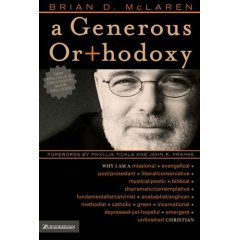
A Generous Orthodoxy -- Brian D. McLaren


A Generous Orthodoxy is perhaps one of the most controversial books written by an evangelical author in the last couple of years. I have read countless blogs and magazine articles which criticize this book from almost every angle possible. When a friend of mine in her 60's asked me some questions about it, I realized that I probably should also read the book. So, over the past couple of weeks, that is what I have been doing. When I have mentioned this to my friends I have received comments ranging from "what a piece of drivel -- can't McLaren stand up for anything" to "what a wonderful book -- I just love it -- my small group is studying it right now."

So, what do I think of the book? Well, while I don't think it is inerrant, or has been written as if dictated by the hand of God, I must admit that I love the book.There are a couple of things that make me go "hmmmm" -- but not in a bad way -- in a way that says I need to think about this more.

In all the critiques I have heard on A Generous Orthodoxy, there have been two things that have been talked about the most -- McLaren's ideas about salvation and the question of Christianity's relationship with other religions. I'd like to say a few words about both of these issues.

Jesus: Saviour of What?

I love what McLaren has to say about Jesus as Saviour.

. . . in Jesus, God is intervening as Saviour. . . by judging (naming evil as evil), forgiving (breaking the vicious cycle of cause and effect, making reconcilliation possible), and teaching (shwoing how to set chain reactions of good in motion). Jesus comes then not to condemn (to bring consequences we deserve) but to save by shing the light on our evil, by naming our evil as evil so we can repent and escape the chain of bad actions and bad consequences through forgiveness, and so we can learn from Jesus the master-teacher to live more wisely in the future. (page 96).

Isn't this a great definition of salvation?

But, this is probably not the controversial issue in regard to salvation. A couple of pages later McLaren syas that he used to believe that Jesus' primary focus was on saving me as an individual and saving other "me's" as individuals. This is of course the whole idea of Jesus as personal saviour. He still believes that Jesus is vitally interested in saving individuals, but McLaren also talks about the idea of Jesus saving the world -- not the idea of universalism, but rather the idea that God is saving us -- so we can be about the establishment of the kingdom of God.

Why this apparent move away from a primary focus on Jesus as personal saviour? McLaren believes that for too many Christians Christians "personal salvation" has become another personal consumer product (like a personal computer, personal journal, personal time, personal trainer, etc.). Salvation is the personal product that will save you from hell. So, in many ways, personal salvation is the ultimate consumerism. As he says:

In a self-centered and hell-centered salvation, doesn't Jesus -- like every company and political party -- appeal to me on the basis of self-interest so that I can have it all eternally and can do so cheaply, conveniently, easily and quickly?

He continues to talk about the fact that if we see salvation as primarily a personal issue, having Jesus as your personal saviour can actually make you more self-centered and less concerned about justice on earth.

McLaren summarizes his thoughts by saying that :

. . . although I believe in Jesus as my personal saviour, I am not a Christian for that reason. I am a Christian because I believe that Jesus is the Saviour of the whole world.

The more I thought about all of this, the more it made sense to me. America has 400,000 churches -- yet Christianity is increasingly become more of a ghetto within American culture rather than a force for positive change. We are planting churches all the time -- often filled with people for whom Jesus is their personal saviour -- yet Jesus seems to make little or no difference in their lives, family or community. Evangelicals have a divorce rate as high or higher than that of the rest of the country. It is hard to find anyone -- religious or not -- that believes that the moral, ethical and social climate in this country is improving. Yet, 400,000 churches and 40% of the population attends church. Why is there no change?

Why are all these churches we are planting not making a difference in our culture? A friend of mine who has worked in SE Asia for the last 10 years believes that perhaps here in North America we have become so concerned about people accepting Jesus as their personal saviour, that we have not seen the whole Gospel. We are planting "harvest" churches -- but not healthy and holistic churches -- churches that understand that the Gospel is not just about seeing people saved -- but also about discipling people (helping people love like Jesus and live like Jesus) and discipling nations (seeing communities transformed by the grace of God). So, instead of planting churches that engage and become part of our communities -- adding value to their communities -- doing what is good for their community, we plant churches that are concerned about personal salvation -- we plant churches for consumers of religious goods and services -- that they add on to the other goods and services they feel are important for leading a life as close as possible to the "american dream".

Something to think about -- don't you agree? Maybe McLaren is on to something here.

Why I am Incarnational

In the chapter on incarnation, McLaren talks about the relationship of Christ with other religions. The controversy surrounds paragraphs such as the following ones from pages 249 and 250.

. . . we are linked and bound through Christ's incarnation all people. I am not saying that all religions are the same, it doesn't matter what you believe, truth is relative . . . I am saying that because we follow Jesus, because we believe Jesus is true, and because Jesus moves toward all people in live and kindness and grace, we do the same.

Because I follow Jesus, then, I am bound to Jews, Muslims, Buddhists, Hindus, agnostics, atheists, New Agers, everyone. . . . Not only am I bound to them in love, but I am also actually called to, in some real sense . . . become one of them, to enter their world and be with them in it.

Radical statement don't you think? McLaren goes on to say that the real enemy is not fundamentalist Islam, but the "McDonaldization and Wal-Martization of the world". The enemy of all people of faith is global consumerism and lust for personal items that make our lives better. I suspect most of us American evangelicals don't see consumerism as the greatest threat to our faith -- but my sneaking suspicion is that McLaren and Jesus are on the same side on this issue.

What does this mean practically? McLaren suggests a number of things.
  • The Christian Faith should become a welcome friend to other religions, not an enemy.
  • We should be a protector of the heritages of other religions and a defender against common enemies.
  • If we are truly to love our neighbour, then we should also be willing to learn from the good that is in our neighbours religion.
  • We must accept the coexistence of different faiths in our world -- willingly, not begrudgingly.
  • We should actually talk with people of other faiths, engaging in humble gentle and respectful dialogue.
  • We should not stereotype people of other religious beliefs.
  • Conversation with other religious faiths does not exclude evangelism, but makes it possible.
  • We must be aware that our "old old story" is not necessarily the true story. In other words, we must be open to the idea that our understanding of the Gospel -- as it was passed down to us by our forefathers -- may have elements of untruth in it.
  • If members of other religions are under threat, we must seek to protect them.
As a . . . Christian, I consider myself not above Buddhists and Muslims and others, but below them as a servant. Better, I consider myself with them as a neighbor and brother (page 263).

Food for thought, don't you think?

McLaren closes the book with the following;

To be a Christian . . . is not to claim to have truth captured, stuffed, and mounted on the wall. It is rather to be in a loving (ethical) community of people who are seeking the truth (doctrine) on the road of mission (witness) and who have been launched on the quest by Jesus, who, with us, guides us still. Do we have it? Have we taken hold of it? Not fully, not yet, of course not. But we keep seeking. We're finding enough to keep us going. But we're not finished. That, to me is, orthodoxy -- a way of seeing and seeking, a way of living, a way of thinking and loving and learning that helps what we believe become more true over time, more resonant with the infinite glory that is God.

My response to that is simple -- AMEN!

Monday, June 19, 2006

Edmonton Oilers Lose the Stanley Cup

It's been a tough year for Canada in hockey. We failed to even get a medal at the Winter Olympics -- that is a national disgrace. And tonight, the Edmonton Oilers lost to the Carolina Hurricanes in Game 7 of the Stanley Cup playoffs.

The fact that Edmonton should never have even gotten this far in the playoffs doesn't really make up for the disappointment of the game tonight. I lived in Edmonton and watched the Oilers play when Wayne Gretzky, Jari Kurri, Mark Messier, Grant Fuhr, etc. won the Cup 4 times. It would have been wonderful if Edmonton could have won tonight -- but it was not to be.

I don't think Americans understand what the Stanley Cup means to Canadians. If there is anything sacred in Canadian society -- it is the Stanley Cup. To win it, is the dream of thousands of boys and young men across the country. When you grow up playing street hockey or in the community rinks, in the towns and cities across the country, every young boy dreams of scoring the winning goal in the Stanley Cup playoffs.

For me as a Canadian living in the USA it is hard for me to believe that the fans in Carolina really understand the significance of the Cup. Somehow it just seems wrong that a team from there (or from Florida in 2004) has the cup. Yes, I know that most of the players are Canadian or European, but somehow that doesn't make a difference. It just seems wrong.

But, there are much more important things in life and in the world than hockey games. I'll feel better tomorrow morning.

Congratulations to the Carolina Hurricanes. They really did play well. And congratulations to the Edmonton Oilers -- at the beginning of the season nobody believed you would go this far.

Saturday, June 17, 2006

Books You Should Read on the Missional Church

Lately I have been reading books on the concept of the missional church -- partly because this is a topic that interests me and partly because I am trying to move the church that I am involved in to become missional.

Here are some of the best books I have read on the missional church issue over the past couple of years.

The Present Future: Six Tough Questions for the Church
- Reggie McNeal

Written primarily to senior pastors and "contemporary" mega-church pastors, Present/Future encourages church leaders to think about 6 questions relating to:
  • replacing church growth with a vision for kingdom growth
  • developing disciples rather than church members
  • fostering new apostolic leadership
  • focusing on spiritual formation rather than church programs
  • shifting for planning for the future to preparation for the challenges of an uncertain world
  • replacing the idea of "every member a minister" to "every disciple a missionary"
For those who have done a lot of reading on the missional church, this book is not revolutionary. However, it will help you begin asking the right questions that can help you begin thinking in a missional direction. It is a great book to give to your senior pastor, church elder, etc.

The Shaping of Things to Come
- Michael Frost and Alan Hirsch

The authors present a new paradigm for doing church and missions. The book lays out the fact that the current western model of doing church is failing, and that attempts to maintain the status quo are most likely futile. Frost and Hirsch go on to present a missional model of the church, that those tied to the status quo will resist. This book is a must read for anyone interested in the future of the western church. BUT, this is probably not the book to give to the senior pastor of a mega-church.

This book resonanted with much of what I have been thinking and feeling over the past few years. My sense is that many mega-churches will be closing their doors in the next 10-20 years. Their campuses will become office complexes and shopping malls. Instead, we will find the growth and development of smaller communities of missional believers who are forming "churches" that look very different. Pottery studios, book stores, community centers, coffee shops, etc. will become the face of Christianity, as we penetrate our culture rather than conform to it or just retreat into our own ghetto.

Transformation: How Glocal Churches Transform Lives and the World
- Bob Roberts

Another book to give to your senior pastor and church leadership that will help them think through the purpose of the church. This book is a call for the church to be missionary -- locally and globally. While there is a strong focus on church planting, the call is to plant churches that are missionary -- churches that want to engage their communities and see them transformed.

Roberts calls these churches "glocal". But the idea here is that glocal churches create disciples who, transformed by the Holy Spirit, infiltrate culture both locally and globally. As God transforms our lives, and those transformed lives form transformed communities, and those transformed communities serve the world locally and globally, community transformation takes place.

Again not a book that is revolutionary if you are familiar with missional church concepts, but one worth giving to those leading churches who are open to thinking in new ways.

Breaking the Missional Code
- Ed Stetzer and David Putnam

A good book for senior pastors and church leaders who have a desire to see the Gospel connect with their communities. Taking much of the good from Donald McGavran, the church growth movement, and the ideas and concepts developing in the emerging church and missional church movements, the authors talk about the need to understand their social context and communicate the message of the Gospel to those they sense God wants them to reach.

The thesis of the book is quite simple.
One size does not fit all, but there are cultural codes that must be broken for all churches to grow and remain effective in their specific mission context. Breaking the Missional Code helps leaders go beyond the idea of becoming "missional" and talks about the implications and consequences of being missional.

One of my favourite ideas in the book is their definition of a disciple. So often discipleship has been defined as someone who knows the Bible, practices the spiritual disciplines, etc. Here is the definition offered by Stetzer and Putnam. A disciple is:
  • someone who loves Jesus and loves like Jesus
  • someone who lives like Jesus
  • someone who leaves behind what Jesus left behind
A definition that is simple, profound and thought provoking. My question is -- am I a disciple?

Friday, June 16, 2006

Race Against Time -- Stephen Lewis

"I have spent the last four years watching people die." This is how Stephen Lewis, the UN Special Envory for AIDS in Africa begins this brilliant book. The book, is a personal account of Stephen Lewis and his experiences in Africa. He is honest, blunt, humorous and pulls no punches. This book is the story of Africa's plight and the wealthy world's betrayal. Much of the book recounts the Millennium Development Goals set by global leaders in 2000 that promised the poor such essentials as primary education, basic health and a reversal of AIDS by 2015. In this book Lewis shows why and how the promises can't be kept, probes the appalling gap between vision and current reality and offers some pathways to attainable solutions.

I too have been profoundly affected by those suffering from HIV/AIDS. In early October 2005 I spent 10 days in Kenya and Malawi mostly with people dying of AIDS. One day we did "home visits" in a Malawi slum. Our group visited about 20+ homes of people who were dying of AIDS or who had family members dying of AIDS. Within two weeks more than 10 of the people we had visited had passed away. I returned from this trip to Malawi changed in profound ways. I have been to more than 30 nations of the world, have spent much time with the poor, but never have I been affected by a trip like this one. Since the October trip I have continued to think about how I should respond to what I experienced. I have responded in a number of ways. In March I worked on a celebrity basketball game that raised more than $50,000 for an AIDS clinic in Malawi. In April, May and June 28 people returned to Malawi to work with those infected and affected by HIV/AIDS. I plan on returning to Malawi in November.

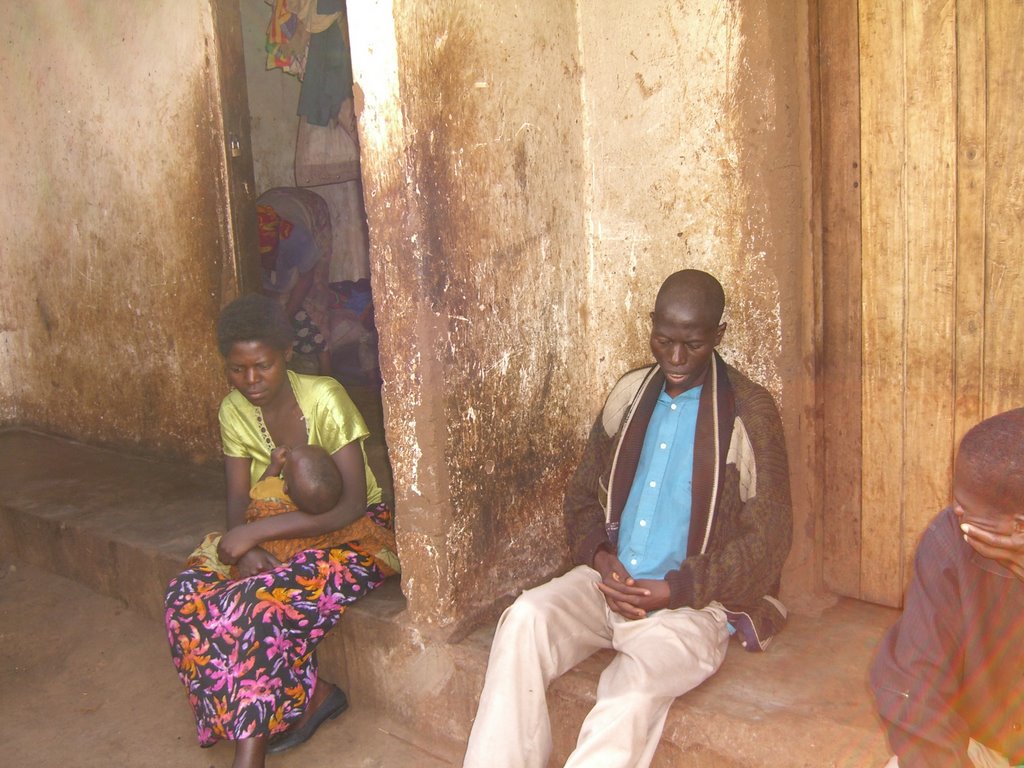
The face of HIV/AIDS in Lilongwe, Malawi
However, I am quite convinced that my involvement must go deeper than simply taking a few trips, writing a book and working on fund-raising events. What that will ulimately mean for me I'm not sure.

At any rate, you need to read Race Against Time. It is an excellent book that will give you an understanding of global issues related to AIDS that is crucial for understanding the related issues.

Sabbatical

I am on Sabbatical!

Wikipedia tells us that a
sabbatical is a prolonged hiatus in the career of an individual taken in order to fulfill some goal. While some sabbaticals can be a year long -- I am thrilled that I am getting 4 weeks + an extra two weeks of holiday time. So, I am simply thrilled.

I have been working at the same place for 7 years now -- the last year was particularily stressful, and I am a more than a bit burned out -- emotionally, socially and spiritually. So, I am looking forward to 4 weeks of little people contact, some good books to read, and a project I am completing on global AIDS which will probably debut in Canada in August, and the USA later on in the year.


This year is also our 25th wedding anniversary, and we are going to Hawaii at the end of July for two weeks. I was able to find a condo for dirt cheap, we are flying to there on frequent flyer miles (my wife in first class, me in coach), renting a car, and then just spending time on the beach, seeing the sites, etc. It should be wonderful. We both love Hawaii and it will be a great way to end my time off.

So, my hope is, that in the next few weeks, I'll be updating this blog quite regularly -- especially with a list of books to read and a few comments about them.

Thank God for Sabbaticals!